.png)
Why Your Shrinking Muscles Are Making You Diabetic

Updated: May 30
How losing muscle mass creates a vicious cycle that hijacks your blood sugar control and packs on dangerous belly fat
Read with full references & citations:
For busy people, or to tune in when on the move, a Google NotebookLM audio podcast is available as a story beneath.
Your skeletal muscle handles 80% of the glucose from every meal you eat, yet most people lose muscle steadily from their thirties onwards. This invisible decline forces your pancreas into overdrive, flooding your system with insulin and driving visceral fat accumulation. Understanding this doom loop might be the most important metabolic insight you'll ever gain.
The Silent Saboteur in Your Body
Picture Sarah, a 45-year-old marketing executive who eats well, avoids sugar, and walks regularly. Her recent blood tests show creeping fasting glucose levels and her doctor mentions "pre-diabetes" for the first time. She's baffled. Her diet hasn't changed, her weight is stable, and she exercises more than most of her friends. What Sarah doesn't realise is that her body has been quietly dismantling its most powerful blood sugar control system for over a decade.
Every year after thirty, we lose between 3-8% of our muscle mass. That might sound trivial, but it's like having your metabolic engine slowly stripped of its parts while you're still trying to drive it at full speed. By the time most people notice something's wrong with their blood sugar control, they've already lost 15-20% of their peak muscle mass. The tragedy is that this loss feels invisible until the metabolic consequences hit like a freight train.
Your muscles aren't just there to help you carry shopping bags or climb stairs. They're your body's primary glucose disposal unit, handling four-fifths of every morsel of carbohydrate you consume. When this system starts failing, your pancreas doesn't get the memo that the problem is muscle loss. Instead, it assumes you need more insulin to force glucose into cells, setting off a cascade that transforms your metabolism from a finely tuned machine into a fat-storing factory.
This isn't just about vanity or looking good in clothes. Muscle loss, technically called sarcopenia, is one of the most underappreciated drivers of type 2 diabetes, cardiovascular disease, and the accumulation of visceral fat that wraps around your organs like a toxic blanket. Yet unlike other risk factors that get plenty of attention, muscle loss happens in plain sight while we focus on everything else.
Your Muscles as Metabolic Warehouses
Think of your skeletal muscle as a vast network of glucose warehouses scattered throughout your body. Each muscle fibre contains specialised storage units called GLUT4 transporters that act like loading docks, rapidly moving glucose from your bloodstream into muscle cells where it can be stored as glycogen or burned for energy. When you have plenty of healthy muscle tissue, these warehouses can handle massive glucose deliveries without breaking a sweat.
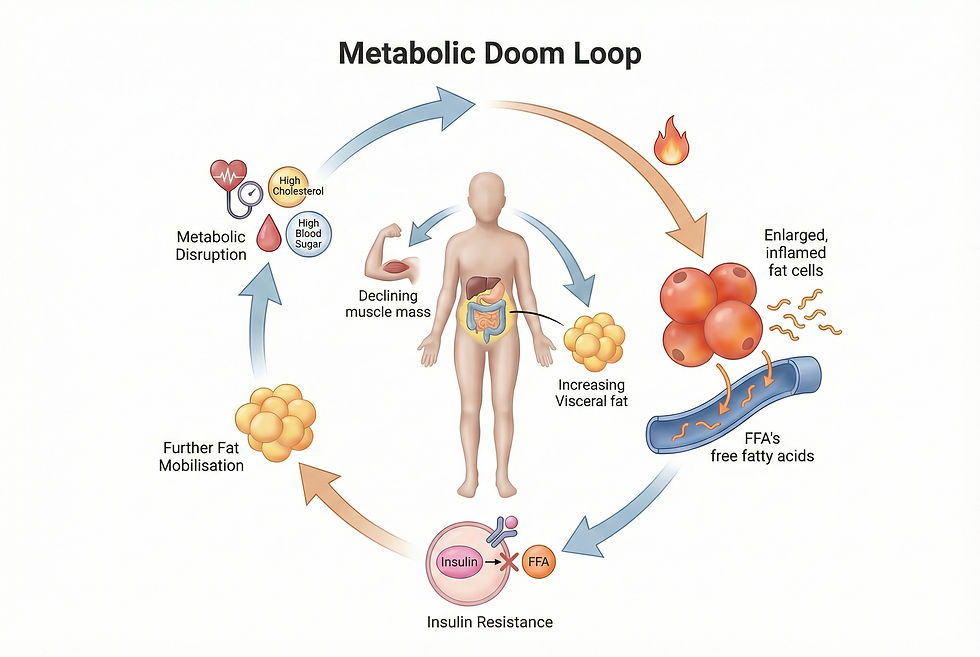
But here's where the doom loop begins. As muscle mass declines, you're essentially closing warehouses while the same amount of glucose keeps arriving. Imagine trying to store the same volume of goods in half the storage space. The result is glucose backing up in your bloodstream, sending distress signals to your pancreas. Your pancreas responds the only way it knows how, by pumping out more insulin to force glucose into whatever storage space remains.
This is where the cycle turns vicious. High insulin levels don't just lower blood sugar; they're also your body's most powerful fat storage hormone. Insulin acts like a metabolic switch, flipping your body from burning mode into storage mode. Worse still, insulin preferentially drives fat storage in your abdominal cavity, creating visceral fat that wraps around your liver, pancreas, and intestines.
This visceral fat isn't passive. It's metabolically active tissue that pumps out inflammatory chemicals called cytokines, which interfere with insulin signalling throughout your body. Now your remaining muscle becomes insulin resistant, meaning even high levels of insulin struggle to move glucose into muscle cells. Your pancreas responds by producing even more insulin, driving more visceral fat storage, creating more inflammation, and further reducing insulin sensitivity. Meanwhile, chronic high insulin levels also accelerate muscle protein breakdown, shrinking your glucose storage capacity even further.
In the UK, this progression often goes unnoticed until HbA1c levels cross the 42 mmol/mol threshold for diabetes diagnosis. In the US, the equivalent marker is 6.5%. By this point, the muscle-metabolism doom loop has been spinning for years, and simply managing blood sugar with medication misses the underlying structural problem.
What You Can Do
Breaking this cycle requires a targeted approach that addresses muscle loss head-on while supporting healthy insulin function. The good news is that muscle responds remarkably well to the right stimulus, even if you're starting later in life.
1. Prioritise resistance training over endless cardio. Your muscles need to be challenged with progressive overload to maintain and build mass. Aim for at least two sessions per week targeting major muscle groups. In the UK, many GP practices can refer you to exercise referral schemes through local councils. In the US, Medicare Advantage plans increasingly cover gym memberships and fitness programs.
2. Dramatically increase your protein intake. Most people consume nowhere near enough protein to maintain muscle mass as they age. Aim for 1.2-1.6 grams of protein per kilogram of body weight daily, spread across meals. For a 70kg person, that's 84-112 grams daily. Include high-quality sources like lean meats, fish, eggs, dairy, or plant-based alternatives like legumes and quinoa.
3. Time your carbohydrates strategically. Consume most of your carbohydrates around your resistance training sessions when your muscles are primed for glucose uptake. This optimises the muscle-building response while minimising insulin spikes at other times.
4. Monitor your progress with body composition tracking rather than just weighing yourself. DEXA scans, available privately in both the UK and US, provide detailed muscle and fat mass measurements. Many pharmacies now offer bioelectrical impedance analysis as a more accessible option.
5. Consider your sleep and stress levels. Poor sleep and chronic stress elevate cortisol, which accelerates muscle breakdown and promotes visceral fat storage. Aim for 7-9 hours of quality sleep and incorporate stress management techniques into your routine.
The VAT Trap Connection
The muscle-metabolism doom loop sits at the intersection of all four metabolic pillars. As muscle mass declines, insulin levels rise to compensate for reduced glucose disposal, directly impacting pillar three. This excess insulin drives visceral fat accumulation around your organs, attacking pillar four while simultaneously increasing inflammatory markers that elevate blood pressure, compromising pillar one.
The inflammatory cascade from visceral fat also interferes with liver function, reducing the clearance of ApoB-containing lipoproteins and driving up the particle numbers that damage your arteries, undermining pillar two. Smoking accelerates this entire process by increasing muscle protein breakdown while promoting inflammation and insulin resistance.
Understanding this connection reveals why focusing solely on diet and cardio often fails to prevent type 2 diabetes. Without adequate muscle mass to handle glucose disposal, even perfect eating can't overcome the metabolic consequences of sarcopenia. The solution isn't just eating less; it's building and maintaining the metabolic machinery your body needs to handle the food you consume.
Key Takeaways
1. Your skeletal muscle handles 80% of glucose from every meal, making muscle loss a primary driver of blood sugar problems.
2. The muscle-metabolism doom loop creates a vicious cycle where muscle loss drives insulin resistance, visceral fat gain, and further muscle breakdown.
3. Resistance training and adequate protein intake are more important than cardio for preventing type 2 diabetes and metabolic dysfunction.
4. Breaking this cycle requires addressing muscle mass directly rather than just managing blood sugar levels with medication.
Summary
Your muscles handle 80% of glucose from every meal, but most people lose muscle steadily after thirty. This creates a vicious cycle where muscle loss forces insulin levels higher, driving dangerous visceral fat accumulation and accelerating metabolic dysfunction throughout your body.
Related Reading
1. Sarcopenia: Are We Diagnosing the Wrong Muscle Problem?
2. The Cardiometabolic Reset: Escaping the Metabolic Doom Loop
3. Visceral Fat, Mitochondria, and the Energy Trap
4. Why HIIT Gets Rid of Visceral Fat
5. Exercise and Digital Tools Should Be First-Line in Reducing VAT
Blog post:
Referenced version (UK English only):


