.png)
BOOK 1 OF THE VAT TRAP SERIES
Sugars, Fats and
Heart Disease
The book that explains why your blood tests can look normal while your metabolism is already in trouble.

From the Naked Heart series — making something complicated simple, but no simpler than the truth allows.
~120 pages 2-hour read. Coming 2026
THE PREMISE
The things your blood tests cannot see
You walk into your GP's surgery for a routine check


The numbers say you're fine.
And yet — your waistband has tightened. Your sleep is patchier. The energy of your forties has quietly drained away. You are doing everything you were told to do.
The numbers are missing something. They have been missing it for decades, and the cost — in heart attacks, strokes, type 2 diabetes, dementia, and several common cancers — has been catastrophic.
THE MISSING PIECE
A puzzle with a piece missing
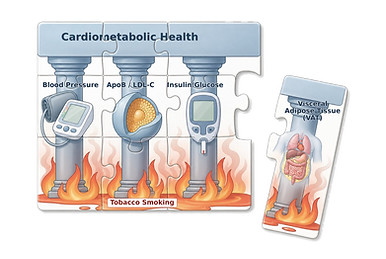
For most of the last fifty years, cardiovascular medicine has rested on three pillars: blood pressure, cholesterol (and more recently ApoB), and glucose. We measure them. We treat them with medication. We tell patients their numbers are fine.
But the pillars stand in fire. And there is a fourth piece of the puzzle that, until very recently, we could not measure properly.
That piece is visceral adipose tissue — VAT.
The metabolically active fat that wraps itself around your liver, pancreas, intestines and heart. Unlike the fat under your skin, VAT is biologically loud. It releases inflammatory signals into your bloodstream around the clock. It drives insulin resistance. It silently inflames the inside of your coronary arteries — and the blood vessels that feed your brain — for years, sometimes decades, before any test you have been offered would pick it up.
Until very recently, we could not see it either. We can now.
WHY NOW?
A trap designed for almost everyone
Why now? Why us? Why this generation?
The modern food environment has been engineered for profit, not for human metabolism. Ultra-processed foods — products formulated in laboratories rather than kitchens — now make up more than half of the calories eaten in the UK and the US. Their architecture is precise: cheap macronutrients (refined starch, industrial seed oils, added sugars) combined to hit what the food industry calls the bliss point — the formulation that makes you eat more without feeling full.
For a substantial proportion of the world's population, this is a metabolic mismatch their genes and gut biome were never designed for. People of South Asian, East Asian, Hispanic and African descent show the steepest rise in visceral fat and the earliest onset of insulin resistance — often at lower body weights than their European counterparts.
And in much of the world, the older industrial assault on metabolic health is still uncontrolled. Tobacco remains widely advertised, cheaply available, and regulated only patchily — particularly across South Asia, the Middle East, parts of Africa, and Eastern Europe. Smoking is not a separate problem from the four pillars. It is the fire underneath all four.
FASHION TITLE
By the time the
bathroom scales
notice, the trap has
been closing for twenty
years.
THE FRAMEWORK
The four pillars of modern
cardiometabolic risk
Modern preventive cardiology rests on four measurements. Each matters. Each can be measured. None of them, on their own, is enough.
PILLAR I
Blood Pressure
The single most modifiable cardiovascular risk factor — and the most poorly measured.
PILLAR II
Apo B/LDL-C
An elevated lipoprotein cholesterol particle count and concentration causes coronary atherosclerosis
PILLAR III
Glucose & Insulin
Carbohydrate sensitivity and insulin resistance happens decades before diabetes appears on a blood test.
PILLAR IV
Visceral Fat (VAT)
The missing fourth pillar — and the master driver of the other three.
"What about exercise, diet, sleep, stress?" The four pillars are not the only things that matter — they are the things that can be measured. Sedentary lifestyle, poor diet quality, insufficient strength training and poor sleep all accelerate the trap; resistance training, dietary change, and good sleep all reverse it. The four pillars give you the dashboard. The lifestyle changes are how you move the needle.
For visceral fat specifically, the most practical home measurement is the waist-to-height ratio — a tape measure and a calculator, repeatable every month, useful anywhere in the world. The threshold to remember is 0.5. CT-based imaging exists as the research-grade reference standard, but for the great majority of people the tape measure carries the framework.
WHAT'S INSIDE
The book is built around three central ideas
Three lenses on the same problem — how the trap forms, what we measure, and how we measure it.
I
II
III
The Trap
How visceral fat accumulates over decades through a slow, almost invisible shift in how the body stores and burns energy. By the time the trap has closed, it has usually been closing for twenty years.
The Pillars
The four measurements that, taken together, reveal what is actually happening in your metabolism. Three of them are familiar. The fourth is the one that was missing.
The Tools
CT imaging with AI analysis, continuous glucose monitoring, ApoB and Lp(a) testing. None of these are yet routinely available on the NHS. Modern preventive cardiology has, at last, the diagnostic toolkit it spent fifty years waiting for.
WHY NOW
From Cardiology 1.0 to Cardiology 3.0
For most of the twentieth century, cardiology was a discipline of reaction. The discipline I trained and practised in for thirty years got better at managing the consequences of heart disease — but still arrived too late.
Cardiology 1.0
SYMPTOM ERA
Recognised heart disease only once it caused symptoms. Diagnosis followed the crisis — it rarely preceded it.
Cardiology 2.0
INTERVENTION ERA
Got better at stenting blocked arteries. Saved lives — but still arrived too late.
Cardiology 3.0
PREVENTION ERA
Sees risk early enough to do something about it — using imaging, AI, metabolic measurement, and an honest understanding of what actually drives disease.
Book 1 is the introduction to that shift, written for the person who suspects their healthcare has been measuring the wrong things, and who wants to understand what the right things are before deciding what to do about them.
A NOTE ON NOISE
Expert advice in a noisy room
The internet has democratised health information. It has also drowned it. On any given day you can find people insisting statins are essential, others insisting they are poison, and a third group selling supplements that will solve everything. Most people have no idea who to trust — and the loudest voices are rarely the most informed.
I cannot make the noise go away. What I can do is offer the considered view of a consultant cardiologist with thirty years of clinical practice, written for the reader rather than the journal, and stripped of every piece of jargon that does not earn its place.
The Naked Heart principle: make
something complicated simple, but no simpler than the truth allows.
Most of your cardiovascular risk — and most of your brain-health risk too — comes from the four pillars in the framework above. Look after these four, and you will look after your heart and your brain. The book series tells you how.
WHO IS THIS FOR
Honest about who this is — and isn't — for
THIS BOOK IS FOR
Anyone over 35 who has wondered why their weight does not match their effort
Anyone interested in modern prevention - Cardiology 3.0
Anyone whose blood tests look "fine" but who does not feel fine
Clinicians — GPs, nurses, dietitians — who want a working framework
for the patient who "shouldn't" have had a heart attack but did
Patients of mine, between consultations
Anyone with a family history that suggests early action would be wise

THIS BOOK IS NOT
A diet book
A fitness manual
A list of supplements
A long read — most readers finish it in under two hours
A substitute for medical advice

The diagnostic foundation that comes before diet, fitness,
or medication — and the book most readers will start with.
Join Dr Leatham’s mission to prevent heart disease and improve your healthspan
Register your interest in The VAT Trap. Gain early access to a new five-part series on metabolic health, prevention, and longevity. Be notified when each volume launches. Access exclusive clinical insights. Follow the evidence and real-world cases behind the science.
Want the full journey? Subscribe to our curated digest of the best blog articles each month, drawn from Vat-Trap, Naked Heart and Surrey Cardiovascular Clinic