.png)
The Four Pillars: A Temple for Your Healthspan

Updated: Jul 3
Strip away the noise and almost everything that shortens a healthy life — heart attack, stroke, type 2 diabetes, much vascular dementia — comes down to four measurable problems. Picture them as four columns holding up the roof you actually live under: your long-term healthspan. When all four stand tall the structure is secure; let one crack and lean, and the whole building is at risk, silently, for years.
Dr Edward Leatham · Consultant Cardiologist · Surrey Cardiovascular Clinic · 2026
For busy people, or to tune in when on the move, a Google NotebookLM audio podcast is available as a story beneath.
One roof, four columns
For most of my career as an interventional cardiologist, the job arrived too late. By the time a patient reached my catheter laboratory with chest pain, the disease had been building silently for twenty or thirty years. We were superb at fixing the crisis and largely powerless to prevent it. Since retiring from the NHS I have spent my time at the opposite end of that timeline — the prevention end — and the further back you look, the simpler the picture becomes.
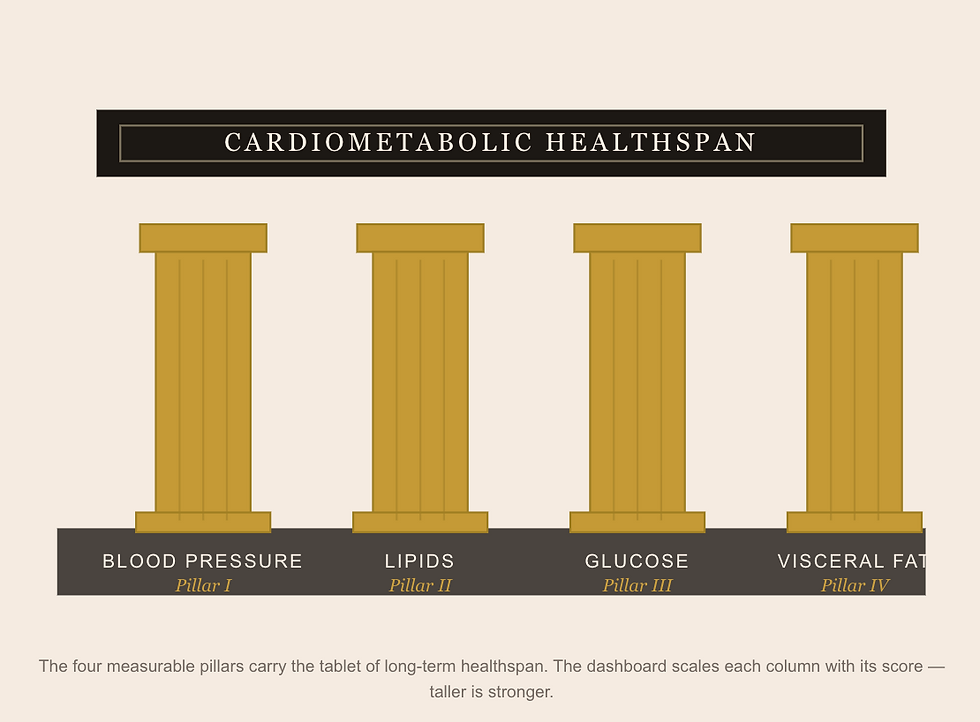
The new Four Pillars dashboard renders the idea literally. A heavy stone lintel — labelled Cardiometabolic Healthspan — sits across the top, supported by four classical columns. Each column is one pillar, and each carries a score from 0 to 100. The taller and greener the column, the better that pillar is supporting you; amber means borderline, and red means the column is doing more leaning than lifting.
Why these four and not a longer list? Because each one is causal (it does real damage, not just travels alongside it), modifiable (you can change it) and measurable (you can track whether you are winning). Cigarette smoke is the obvious fifth element — but rather than a column, think of it as the fire or earthquake that burns or shakes all four at once, so we treat it as a hazard to remove rather than a pillar to build.
The four measurable pillars
Pillar I · Blood Pressure — the slow, silent pressure that ages every vessel
Raised blood pressure is the single most common reason an artery wears out early. It batters the lining of vessels throughout the body, stiffens them, and is the strongest modifiable risk factor we have for vascular dementia as well as stroke and heart attack. The crucial point is that it is symptomless for years — you cannot feel 150/95.
What we track: a properly measured upper-arm reading, taken seated and rested. For most people at cardiometabolic risk we aim below 130/80 mmHg, and the SPRINT-MIND trial showed that pushing systolic toward 120 mmHg reduced the onset of mild cognitive impairment.
Pillar II · Lipids — ApoB, the principal villain
Everyone who develops coronary disease has cholesterol-laden plaque in their artery walls, and the particle that drives it is the one carrying apolipoprotein B (ApoB) — chiefly LDL. The longer and lower your ApoB is kept, the lower your lifetime risk, and there is no convincing evidence that a very low level does harm. What a standard cholesterol panel can miss is the number of particles: two people with identical LDL cholesterol can carry very different particle counts, and the small, dense LDL pattern that comes with metabolic trouble is especially damaging.
What we track: ApoB ideally, alongside LDL-C. For higher-risk patients we target LDL-C below 1.8 mmol/L (70 mg/dL), lower still in the highest risk. A high triglyceride with a low HDL is the fingerprint of the metabolic, small-dense-LDL route — and that points straight at Pillar IV.
Pillar III · Glucose & Insulin — the damage that starts decades before “diabetes”
By the time a blood test flags type 2 diabetes, the underlying problem — insulin resistance — has usually been running for ten or fifteen years. Repeated glucose spikes and the high insulin levels needed to control them inflame vessels, drive fat storage and accelerate ageing in the brain as well as the heart. A single fasting glucose or even an HbA1c can look reassuring while the daily pattern tells a very different story, which is why I increasingly use continuous glucose monitoring to read a person’s real-world glucose profile rather than one snapshot.
What we track: HbA1c and fasting glucose as the baseline, and where it adds value, a week of continuous glucose monitoring to grade the size and frequency of spikes. Flat and steady is the goal; frequent or prolonged excursions are the early warning.
Pillar IV · Visceral Fat (VAT) — the column that quietly cracks the other three
This is the pillar conventional check-ups still overlook, and the one the whole series is built around. Visceral adipose tissue — the active, inflammatory fat packed around your internal organs — is not inert storage. It behaves like a rogue endocrine organ, and its influence reaches across the temple: it pushes blood pressure up through inflammatory and nervous-system pathways, it signals the liver to make the small, dense LDL particles of Pillar II, and it is a principal driver of the insulin resistance behind Pillar III. Most insidiously it feeds itself — high insulin stores more fat, which raises insulin further — the metabolic doom loop.
This is why someone can be slim, have “normal” blood tests and the right prescriptions, yet still carry a hidden burden of organ fat that is steadily weakening the structure. We call it the thin-outside-fat-inside picture, and the bathroom scales will never reveal it.
What we track: the simplest powerful number you own — waist-to-height ratio, ideally kept below 0.5. A waist measured correctly at the midpoint between lowest rib and hip bone, above 94 cm (men) or 80 cm (women), flags increased risk. Where it matters clinically, a CT scan can quantify visceral fat directly.
THE KEYSTONE INSIGHT Visceral fat is not just one of four equals. Because it actively undermines the other three columns, lowering it is often the single most efficient move you can make — improve Pillar IV and blood pressure, lipids and glucose frequently improve with it. That is the central argument of The VAT Trap: treat the fat that is sabotaging the building, and you reinforce the whole temple at once. |
Why a single Healthspan score?
It is easy to feel reassured by one good number and ignore three mediocre ones — but a temple does not care that one column is magnificent if another is crumbling. The dashboard therefore does two things at once: it shows each pillar individually, and it combines them into one Healthspan score out of 100, with a gauge that swings from “unhealthy” to “healthy”. The aim is not a perfect mark; it is to see, at a glance, which column most needs your attention next.
This is the difference between lifespan and healthspan. Modern medicine is good at keeping people alive after a cardiac event, and far less good at protecting the disease-free, fully-functioning years beforehand. The four pillars are levers on healthspan specifically — and because what is good for the heart is good for the brain, strengthening them lowers the risk of dementia and several cancers along the way, not only heart attacks.
Worked example: meet Dave
Dave is 54, not overweight on the scales, and his GP told him his cholesterol was “fine”. On the dashboard his columns came out close together and all amber — blood pressure 50, lipids 52, glucose 50, visceral fat 48 — for an overall Healthspan score around 49 out of 100: borderline. Nothing screaming for an ambulance, which is exactly the problem. Four columns all leaning slightly is not four small issues; it is one structure under broad strain.
His weakest pillar was visceral fat, and his waist-to-height ratio (0.58) confirmed it. Rather than chase four separate fixes, we started with the keystone — reducing VAT through diet, resistance training to rebuild muscle, and targeted treatment. As Pillar IV strengthened, his glucose pattern settled and his blood pressure eased. One lever, several columns reinforced.
See your own four pillars
The Four Pillars dashboard turns your numbers into one Healthspan score and shows you which column to shore up first — no sign-up required. No numbers yet? Start with the one anyone can take at home: your waist.
Open the Four Pillars dashboard →
Related Reading
1. Optimal Blood Pressure: How Low is Low Enough?
https://www.scvc.co.uk/high-blood-pressure/optimal-blood-pressure-target/
2. Cardiovascular Prevention: Why Waiting Until 60 Is Too Late
https://www.vat-trap.com/post/cardiovascular-prevention-why-waiting-until-60-is-too-late
3. Your Roadmap to CHD Prevention: A 4-Step Guide
https://www.vat-trap.com/post/your-roadmap-to-chd-prevention-a-4-step-guide
The take-home message
Almost all preventable cardiometabolic disease traces back to four measurable problems — raised blood pressure, raised ApoB, disordered glucose and insulin, and excess visceral fat — which together hold up, or undermine, your long-term healthspan. Visceral fat is the keystone, quietly cracking the other three, which is why lowering it is so often the most efficient intervention. See all four columns and your combined Healthspan score in one view, decide which to strengthen first — and remember the simplest place to begin is a tape measure.
Key Takeaways
• Long-term healthspan rests on four measurable cardiometabolic pillars: blood pressure, lipids, glucose & insulin, and visceral fat.
• Each pillar is causal, modifiable and measurable — and each is dangerously silent for years.
• ApoB (not just LDL-C) is the lipid number that matters most; the lower and longer, the better.
• Visceral fat is the keystone: it actively weakens the other three pillars, so lowering it often improves them all at once.
• A single combined Healthspan score stops one good number from masking three weak ones.
• The easiest first measurement is your waist-to-height ratio — aim to keep it below 0.5.
https://mhaat.vercel.app/four-pillars-healthspan.html
Read the referenced version (with citations) at the link above.
This article is for educational purposes only and does not constitute medical advice. The views expressed are the personal views of Dr Edward Leatham and do not necessarily represent a consensus view. Always consult a qualified healthcare professional before making changes to your health, medication, or exercise regimen. © 2026 Medicalspace Ltd / E. Leatham. All rights reserved.
