.png)
THE VAT TRAP · CARDIOLOGY 3.0
The VAT Trap Blueprint
How to lose harmful visceral fat — and keep it off. One page you can return to, built on the strongest available evidence.
Visceral fat — the fat stored around your organs — is the kind that drives cardiovascular and metabolic disease. It responds not to what you endure for twelve weeks, but to what you do repeatedly for decades. This is the plan we use, distilled to a single page: a non-negotiable bedrock that captures most of the benefit, and a set of options useful for some and mandatory for none.
Why we built this
Almost everyone who arrives at the clinic with a raised waist has already tried to read their way out of it. They come having worked through several books and a great many blogs, and having been told with equal confidence that cholesterol is nothing to worry about, that vegetables are the problem, that fat is the enemy, that fat is the answer. The advice contradicts itself at every turn, and much of it is delivered with more certainty than the evidence can support.
People in that position are not short of willpower or of information. They are short of a straight answer. This page is our attempt at one: the plan we actually use, set out as simply as we can make it.
So it is deliberately plain, and deliberately cautious. Everything in the bedrock is something we would still stand behind if the fashionable claim of the moment turned out to be wrong. Where the evidence is strong, we say so and link to it. Where we are working from clinical experience, or from a mechanism that is still a working hypothesis, we say that too — and we always tell you which of the two you are reading.
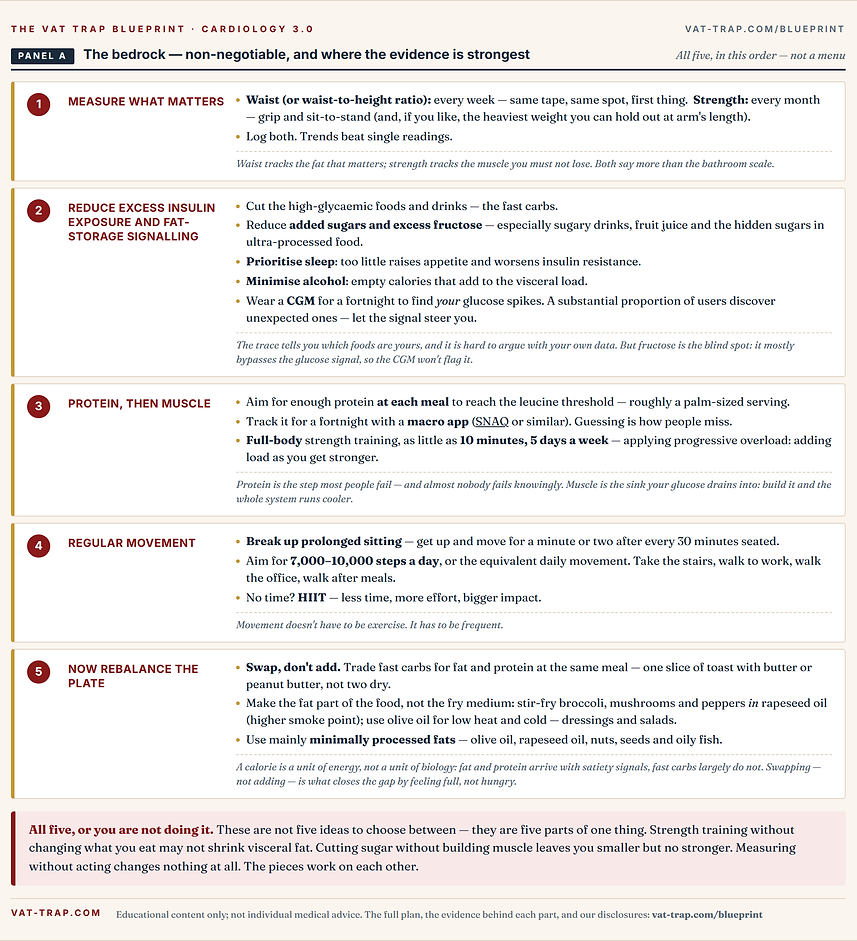
Panel A — the bedrock. Non-negotiable, and where the evidence is strongest.

Panel B — the options. Useful for some, mandatory for none.
What about diets?
The question everyone asks is which diet. We are deliberately unfussy about the answer, because there is more than one way to do this, and the one that works is the one you can still be doing in ten years.
Low-carbohydrate, keto and Atkins are all reasonable options, and can be genuinely useful for people whose CGM shows large, repeated spikes. Our reservation is not whether they work — it is whether they can be sustained, because — as Panel B puts it — a diet you abandon has failed, however well it performed while you were on it. So we favour a balanced way of eating that uses the same tricks without the strict rules: enough protein and fibre at every meal, fast carbohydrate traded for protein and fat rather than simply removed, and a clear eye on where the sugar is hiding.
That last point deserves emphasis, because modern food is sweeter than it looks. Some flavoured and instant oat products arrive with sugar already added, before anyone reaches for the honey. Fruit that has been blended or juiced delivers its fructose far faster than fruit that has been chewed — smoothies and orange juice belong on the list. A CGM will find your glucose spikes for you, but it will not flag fructose, which is exactly why this has to be said out loud rather than left to the trace.
And yes: losing visceral fat requires an energy deficit. We would far rather you arrived at one by eating food that leaves you full than by dieting hard enough to feel it, because hunger is what ends most attempts — and sharp restriction takes muscle before it takes visceral fat.
Eating within a window, or an occasional longer fast, is a perfectly reasonable way to reach that deficit — and for some people an easier one, because a closed kitchen removes the decision rather than asking you to win it again every evening. There is some trial evidence that a restricted eating window improves insulin sensitivity beyond what the weight loss alone accounts for, though it is not consistent, and the fair reading is that most of the effect comes from simply eating less. That does not make it less useful.
Few people keep strict fasting up for years. A small number of our patients do, and do very well on it — but for most it works best as something used for a season rather than adopted for life, and it should never displace the protein and strength work in Panel A. Anyone taking insulin, a sulfonylurea or a GLP-1 needs specific advice before fasting at all.
How to use this
The two panels above are the whole plan at a glance. Each of the six parts below opens a short, plain-language guide — and, for anyone who wants it, a link to the published evidence behind that part. You never need the evidence to follow the plan; it is there so that nothing here has to be taken on trust.
The six parts
Five make up the bedrock. The sixth is the optional extras.
1
BEDROCK
Measure what matters
Waist (or waist-to-height ratio) and strength — the two numbers that say more than any scale.
BEDROCK
2
BEDROCK
Reduce excess insulin
Cut fast carbs and added sugar; protect sleep; go easy on alcohol; use a CGM to find your own spikes.
3
BEDROCK
Protein, then muscle
A palm of protein each meal, and ten progressive minutes of strength work — the engine that burns your glucose.
4
BEDROCK
Regular movement
Break up sitting, aim for daily steps or their equivalent. Movement doesn't have to be exercise — it has to be frequent.
5
BEDROCK
Rebalance the plate
Swap, don't add: trade fast carbs for fat and protein, and make good fats part of the food.
6
OPTIONS
The options
Time-restricted eating, longer fasts, keto and GLP-1 at the lowest effective dose — useful for some, mandatory for none.
All five bedrock parts work on each other — they are five parts of one thing, not a menu to choose from.
Disclosure. Educational content only; not individual medical advice. The sequence shown reflects the approach used in our cardiometabolic clinic and a working view of the mechanisms — it is not a settled protocol. The leucine-threshold and per-meal protein targets are best-estimate guidance rather than established thresholds for visceral fat loss.
Panel B describes options, not recommendations. The low-dose GLP-1 approach reflects our clinical experience and does not correspond to licensed dosing schedules; GLP-1 receptor agonists are prescription-only medicines requiring medical supervision. Fasting requires specific advice for anyone taking insulin, a sulfonylurea or a GLP-1. Decisions about medication, heavy training or fasting should be made with your own clinician.
Apps and devices are named as examples only; we have no commercial relationship with them. Dr Leatham is a director of Surrey Cardiovascular Clinic, Medicalspace Ltd and Virtual Cath Lab Surrey Ltd / Heart Scan Direct. An educational project of Medicalspace Ltd — full disclosures at vat-trap.com/disclosures.
The VAT Trap · vat-trap.com · scvc.co.uk
© 2026 Medicalspace Ltd. The evidence notes and white papers are published open-access under CC BY 4.0.